Advanced TypeScript Patterns for Library Authors

Use advanced TypeScript patterns to design public library APIs that stay expressive, readable, and maintainable for downstream teams.
Advanced TypeScript becomes useful for library authors when it keeps the public API precise without forcing consumers to learn your implementation tricks. The job is not to maximize type cleverness. The job is to make invalid states hard to represent and valid usage easy to discover.
This tutorial focuses on patterns that improve library ergonomics without turning declarations into puzzles.
This TypeScript tutorial is most useful when you are designing public APIs that need to stay stable across many downstream use cases.
Design the runtime API before the type API
TypeScript can hide a weak runtime design for a while, but consumers eventually feel the mismatch. Build the JavaScript API first:
- What is the smallest useful call shape?
- Which defaults should be explicit?
- What errors need to be prevented at compile time?
Once the runtime contract is stable, use types to describe it. Do not let type gymnastics invent extra API surface you would not ship in plain JavaScript.
Use constrained generics to preserve intent
Constrained generics are valuable when they carry real relationships through the API.
type FieldMap = Record<string, unknown>;

export function defineConfig<TFields extends FieldMap>(config: {
  fields: TFields;
  defaults?: Partial<TFields>;
}) {
  return config;
}
This pattern keeps the library aware of the consumer's field shape without forcing repetitive annotations at each call site.
Reach for conditional types when return shapes truly branch
Conditional types help when the runtime behavior really does diverge. They are overkill when a union return type would already be understandable.
Good use cases include:
- Builder APIs that change available methods after configuration
- Serialization helpers that map optional flags to explicit output shapes
- Event systems that infer payload types from event names
If the runtime always returns the same shape, keep the type simple.
Stabilize the public surface with helper types
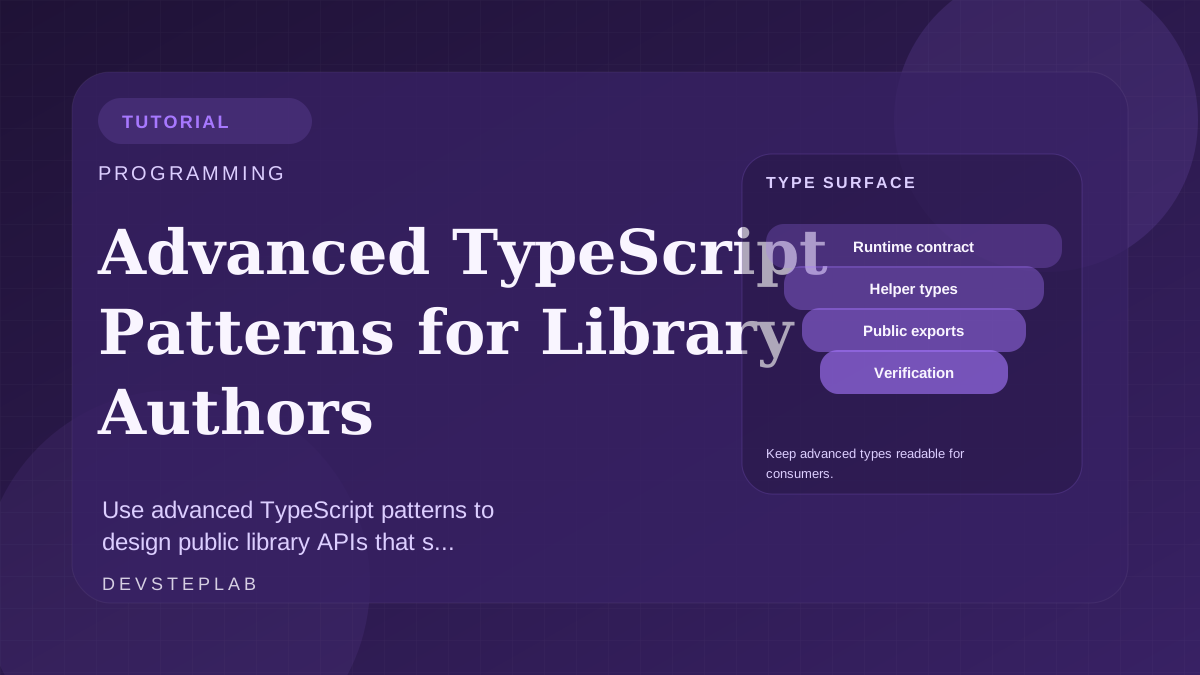
It is often better to expose one or two named helper types than to export every intermediate piece:
ResolvedConfig<T>PluginContext<TEvents>ActionResult<TData, TError>
This gives consumers a stable mental model and gives you room to refactor internal declarations later.
The same principle applies to framework code. In Building a Full-Stack App with the Next.js App Router, stable boundaries matter more than clever implementation details.
Test types like production behavior
Type-level regressions are still regressions. Add examples that prove:
- valid calls compile
- invalid calls fail
- inferred return types match the documentation
For library authors, the type system is part of the shipped product. Treat it as such, but keep it legible enough that consumers can reason about it without reading your entire source tree.
Related next reads
Frequently Asked Questions
Should library authors expose every clever utility type they create?
No. Public types should support the API contract, not show off the internal type system. The maintainable choice is usually the simplest type surface that still preserves correctness.
How do I keep advanced types from hurting compile performance?
Prefer shallow composition, avoid deeply recursive public types unless they are essential, and benchmark large consumer projects before locking the API.