Building Scalable APIs with Go and Gin

Learn how to build scalable Go APIs with Gin, from routing and dependency boundaries to concurrency, observability, and latency control.
Scalable APIs are usually the product of clear boundaries rather than exotic frameworks. Go and Gin make it easy to get a service running quickly, but keeping it fast and maintainable under load requires discipline around request flow, state, and dependency ownership.
This guide focuses on those structural decisions.
Scalable APIs are usually the result of clearer service boundaries, dependency control, and latency-aware handler design.
Keep request handling thin
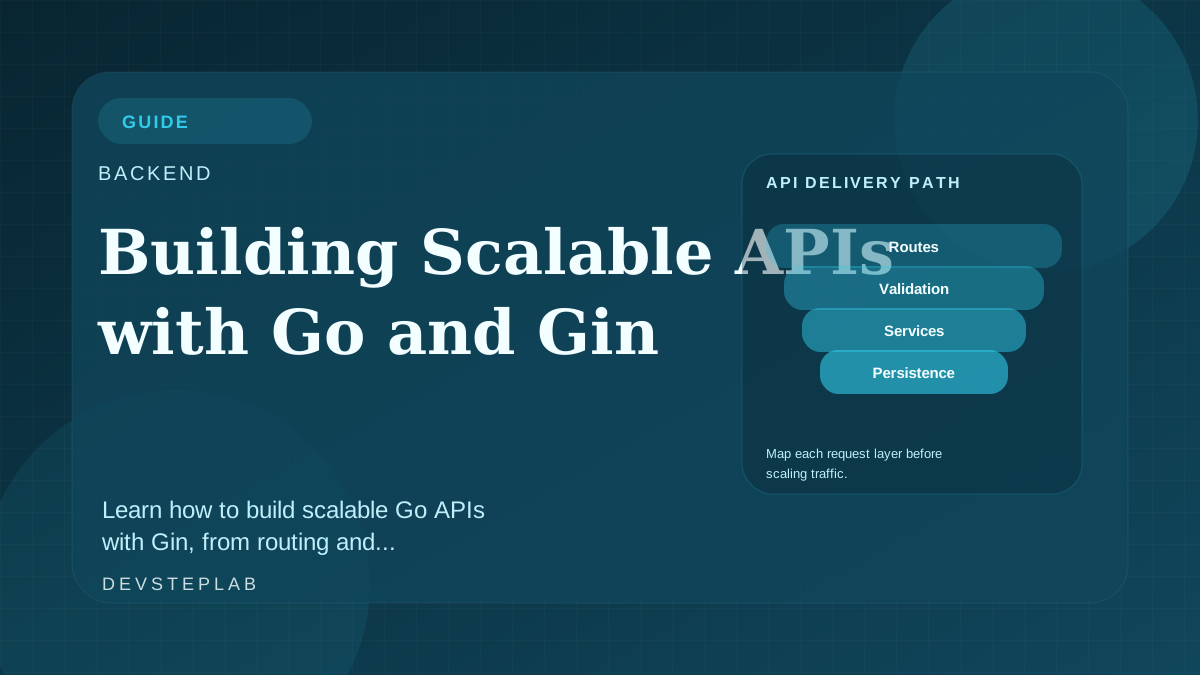
HTTP handlers should do three jobs:
- parse and validate input
- call the service layer
- map results into HTTP responses
When handlers also own business rules, persistence logic, and background side effects, API behavior becomes hard to test and even harder to scale coherently.
Manage shared dependencies explicitly
Treat database pools, caches, and outbound clients as explicit dependencies rather than global state.
type Server struct {
    DB    *sql.DB
    Cache *redis.Client
}

func (s *Server) RegisterRoutes(router *gin.Engine) {
    router.GET("/health", s.healthHandler)
    router.GET("/accounts/:id", s.accountHandler)
}
This keeps the service graph visible and makes it easier to reason about connection pressure, startup failure, and testability.
Concurrency is a design tool, not a reflex
Go makes concurrency easy to express, but that does not mean every request path should spawn goroutines. Use concurrency when it simplifies coordination or improves latency predictably.
If you need the language-level mental model first, Mastering Concurrency in Go: Channels vs Mutexes is the right complement to this guide.
Make performance observable
Scalable APIs need visibility into:
- request latency by route
- database and cache timings
- saturation signals
- error rate by dependency
Without this, “performance tuning” becomes a cycle of framework tweaks that rarely touch the real bottleneck.
Scale by simplifying the hot path
The request path that handles the most traffic should be the easiest path to explain:
- minimal allocations
- predictable downstream calls
- bounded retries
- explicit timeouts
Framework choice matters less than whether the API surface is structured so those properties remain obvious over time.
Related next reads
Frequently Asked Questions
Is Gin required to build high-performance APIs in Go?
No. Gin is one practical framework choice, but performance and scalability depend more on service design, dependency management, and request lifecycle discipline than on the router alone.
When should I split one Go API into multiple services?
Split only when boundaries are real: different scaling characteristics, ownership, or operational needs. Premature service splits often add latency and complexity without improving throughput.