Rust for JavaScript Developers

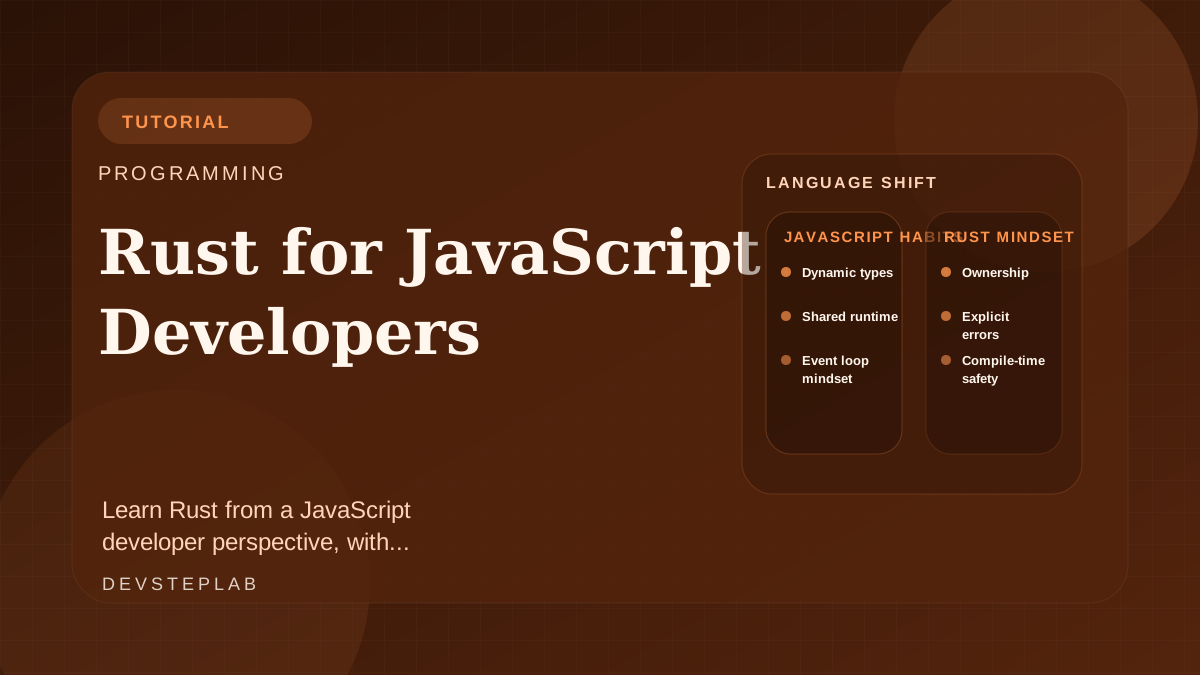
Learn Rust from a JavaScript developer perspective, with practical explanations of ownership, borrowing, error handling, and data modeling.
Rust feels difficult to JavaScript developers mostly because it forces resource ownership to be explicit. That is unfamiliar at first, but it also makes many classes of runtime bugs harder to ship.
This tutorial maps the main Rust concepts to mental models web developers already use so the language feels less alien.
Rust becomes easier when JavaScript developers map ownership and borrowing to predictable resource lifecycles instead of memorizing syntax alone.
Ownership is about who controls a value
In JavaScript, you rarely think about who owns a piece of data after it is passed around. Rust makes that relationship explicit.
- A value has one owner at a time.
- Moving the value transfers that ownership.
- Borrowing lets you read or mutate without taking ownership.
That model is restrictive at first, but it is also what lets the compiler prevent dangling references and data races.
Borrowing replaces a lot of defensive copying
References let functions inspect or mutate values without taking them over.
fn print_name(name: &String) {
    println!("{name}");
}

fn append_version(name: &mut String) {
    name.push_str(" v2");
}
The compiler enforces when immutable and mutable references can coexist. That is stricter than JavaScript, but it removes a large class of accidental shared-state bugs.
Results and enums make failures explicit
Rust prefers return values like Result<T, E> over exception-driven flow. For JavaScript developers, this feels closer to disciplined async error handling than to implicit throw/catch behavior.
That explicitness is one reason Rust code tends to surface edge cases earlier. The language keeps asking what happens when the operation fails.
Think in data models, not only control flow
Enums with pattern matching are one of the most useful jumps for application developers:
- model valid states directly
- force exhaustive handling
- avoid boolean and stringly-typed state machines
This is a good complement to content in the Programming Tutorials & Guides hub because it changes how you model application correctness, not only how fast the code runs.
Learn the language in layers
Do not try to absorb the whole ecosystem at once. A practical progression is:
- Ownership and borrowing
- Structs, enums, and pattern matching
Result,Option, and error handling- Traits and generics
- Async and concurrency
Once those pieces are stable, the rest of the language feels much less intimidating.
Related next reads
Frequently Asked Questions
Is ownership the same as manual memory management?
No. Ownership is a compile-time model that lets Rust enforce memory safety automatically. You still write normal application code instead of manually allocating and freeing memory everywhere.
Should JavaScript developers learn lifetimes immediately?
No. Start with ownership, borrowing, and enums first. Most practical learning friction goes down once those core ideas click.