Mastering Node.js: From Beginner to Production

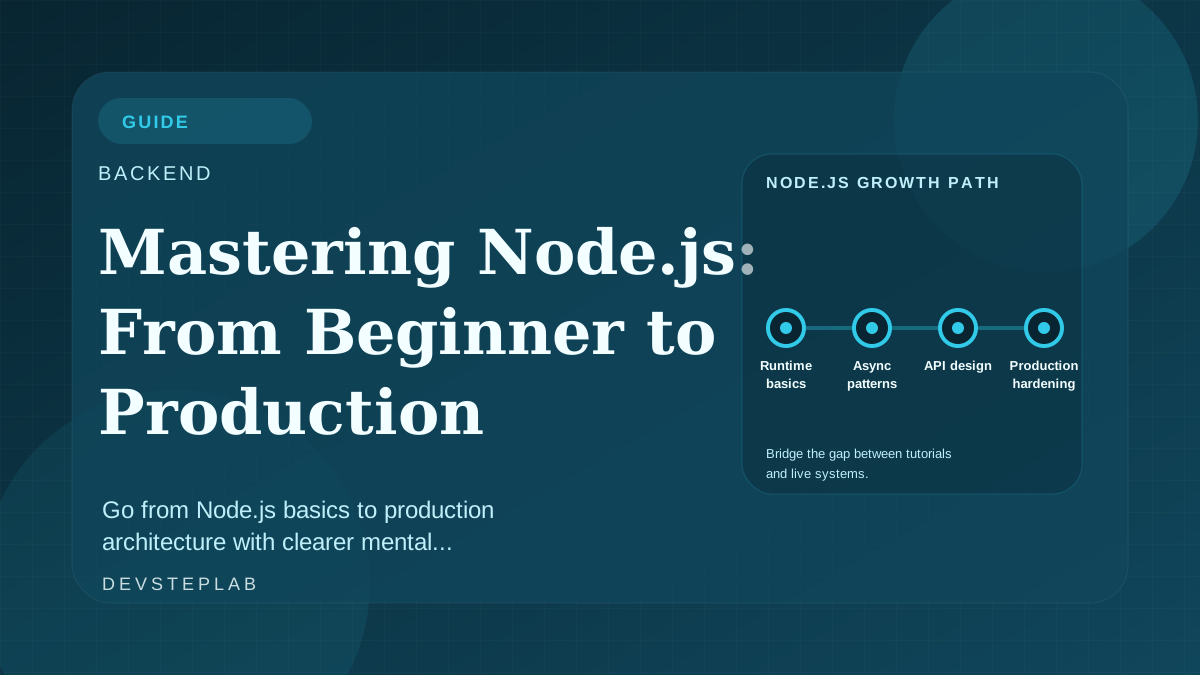
Go from Node.js basics to production architecture with clearer mental models for the event loop, async I/O, service structure, and deployment.
Node.js is easy to start and easy to misuse. The runtime can carry a lot of production traffic, but only when teams respect what the event loop is good at and what should be pushed into other boundaries.
This guide connects the beginner mental model to the operational decisions that matter later in deployment.
Node.js becomes production-ready when developers understand the event loop, async I/O, process design, and deployment constraints together.
Know what the runtime optimizes for
Node.js is strong when the workload is I/O-heavy and latency depends on handling many concurrent waits efficiently. It is weaker when CPU-heavy work blocks the event loop and prevents the process from serving other requests.
That is why understanding async behavior still matters. If you need a refresher, Understanding the JavaScript Event Loop is the right precursor.
Structure the service around responsibilities
Production Node.js code gets simpler when the application is split by responsibility:
- request parsing and validation
- business logic
- persistence and external integrations
- background jobs
That keeps routing code small and makes the runtime behavior easier to profile and observe.
Be deliberate about concurrency
Node.js can handle a lot of concurrency, but that does not mean every task belongs on the main process. Offload:
- long-running exports
- image and document processing
- expensive analytics transforms
- unreliable third-party retry work
Queues and worker processes protect the request path. They are not a premature optimization when the workload justifies them.
Production readiness is mostly operational discipline
A reliable service needs:
- health checks that prove dependencies are usable
- structured logs with request identifiers
- timeouts and cancellation around external calls
- graceful shutdown on deploy or scale-down
If you are packaging the service for deployment, pair this guide with Dockerizing a Node.js Application for Production so the runtime contract and container contract stay aligned.
Scale by reducing surprises
Performance work in Node.js is not only about raw speed. It is about removing unpredictable behavior:
- memory leaks from long-lived object graphs
- blocked event loops during peak load
- connection pools sized without evidence
- caches that hide consistency problems until traffic increases
The best production Node.js services are boring in the right way. Their control flow is understandable enough that the runtime stays predictable under load.
Related next reads
Frequently Asked Questions
Is Node.js a bad choice for CPU-heavy workloads?
Not necessarily, but CPU-heavy work needs explicit isolation through worker threads, queues, or service boundaries. The mistake is forcing the main event loop to carry compute-intensive work directly.
Do production Node.js services always need a framework?
No. A framework can improve consistency, but the important part is a clear process model, observability, and well-defined service boundaries.